
SJAEC CTE Exploration Tours: Adult Education to Career Pathways at San Joaquin Delta College
Submitted By: Heather Maloy
Delta Sierra Regional Alliance(San Joaquin Delta)
Website: https://www.sjadulted.org/
Type of Practice: Learner Transition
Program Area(s): CTE / Workforce Prep / Pre-apprenticeship
Region: Northern California
Consortia Involved: Delta Sierra Regional Alliance (San Joaquin Delta)
The Program of Practice
San Joaquin Delta College respectfully submits the SJAEC CTE Exploration Tours for consideration as a CAEP Model Program. This practice is a collaborative transition strategy that brings adult education students from consortium partners onto the Delta College campus for structured exploration of Career Technical Education and workforce pathways.
The tours are designed to move adult learners beyond general awareness and into direct exposure to college-based career programs, facilities, faculty spaces, and workforce-connected opportunities. Rather than relying only on outreach materials or presentations, this model gives students a firsthand introduction to CTE programs and helps them visualize themselves as future Delta College students. The approach supports learner transition, college knowledge, and career momentum by making pathways visible, tangible, and accessible. Adult learners often express interest in better jobs, short-term training, and livable wage careers, but many do not have enough exposure to college career pathways to make informed next-step decisions. For adult school students, especially those returning to education after time away, college can feel unfamiliar and intimidating. Without direct and structured pathway exposure, students may not move from adult education into postsecondary CTE programs even when those opportunities align with their goals.
This challenge is especially important in the Stockton region. Your Adult Education presentation shows that Stockton has a population of 324,975, with 73,119 adults lacking a high school diploma. It also notes that education improves employment opportunities, income potential, health outcomes, and the local economy, while emphasizing that CTE programs help students gain real-world skills, enter the workforce faster, and access livable wage occupations.
The consortium data further show the scale of need and opportunity. In 2024–25, the San Joaquin Adult Education Consortium served 7,097 students, with the largest age group being 25–44 years old, demonstrating that the region serves a large adult learner population in prime working years.
The Response
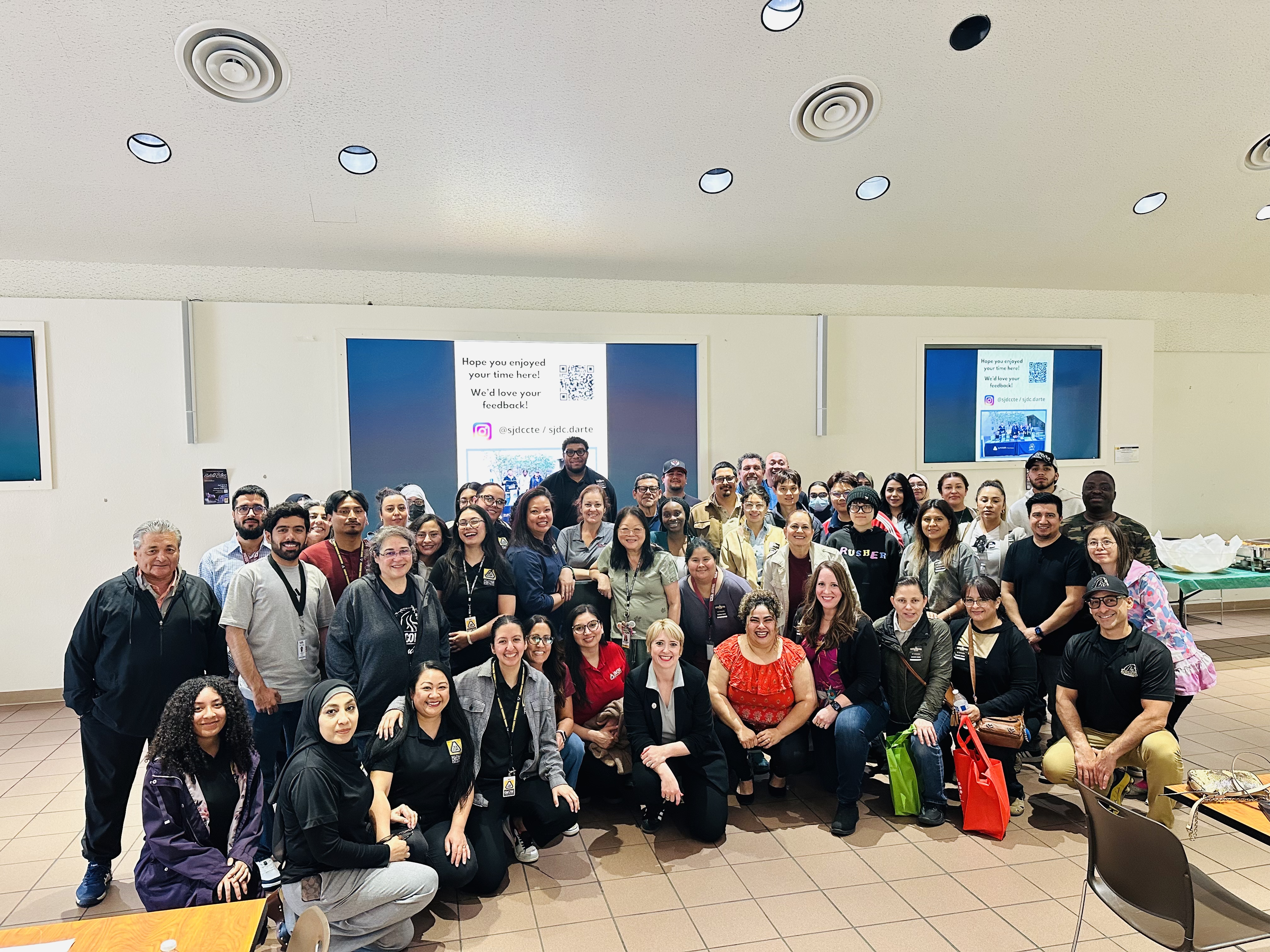
To address this problem, San Joaquin Delta College and the San Joaquin Adult Education Consortium developed the SJAEC CTE Exploration Tours as an intentional learner transition strategy. The tours bring adult education students to campus for a structured experience centered on direct exposure to CTE programs and the Workforce Development Center.
According to the uploaded agenda, the tours were scheduled for April 15–16 and included organized rotations through major workforce-aligned programs. Students visited or were introduced to Diesel Mechanics, Electrical, Nursing, Automotive, Welding, and Machine Technology, with the day anchored through the CTE and Workforce Development Center in Shima 217 and including a shared lunch in Upper Danner. The schedule also shows a two-group structure, suggesting thoughtful planning to maximize student exposure and program access.
This response is powerful because it moves beyond passive outreach. Students do not simply hear about programs; they physically enter the instructional spaces, see equipment and labs, and gain a clearer understanding of what each pathway could look like for them. This creates a stronger bridge from adult school to college and supports more informed decisions about enrollment, certificates, and career goals.
The Unique Features of the Program
This program merits CAEP Model Program recognition because of several distinctive features.
First, it is a high-impact transition practice grounded in direct learner experience. Many transition efforts focus on information sharing alone, but this model uses campus immersion and structured pathway exposure to increase confidence and belonging.
Second, it is deeply connected to regional workforce preparation. The tour agenda highlights career programs with strong workforce value, including Diesel Mechanics, Electrical, Nursing, Automotive, Welding, and Machine Technology. These are not abstract pathways; they are concrete, hands-on programs tied to employment and technical skill development.
Third, the tours are intentionally embedded within a broader adult education-to-college pipeline. Your presentation emphasizes the importance of promoting CTE, expanding short-term certifications, strengthening transitions, and aligning Adult Education, DARTE, and SB 554 pathways. This shows that the tours are not a standalone event, but part of a larger regional strategy to move adult learners into college and workforce opportunities.
Finally, the program is equity-centered. Because adult learners may be first-generation college students, multilingual learners, or individuals re-engaging after interrupted schooling, physically welcoming them into CTE spaces reduces barriers and helps transform uncertainty into possibility.
The Outcome
The SJAEC CTE Exploration Tours demonstrate promise as a replicable transition model because they respond directly to documented regional need and align with adult learner pathway goals.
The strongest supporting regional data come from the 2024–25 Adult Education presentation. The consortium served 7,097 students, and the presentation explicitly identifies CTE promotion and expanded pathway access as important responses to community need. It also highlights that education and workforce training are essential for increasing employment opportunities, improving income potential, and supporting stronger families and a stronger local economy.
The tours operationalize that vision. On April 15–16, students were brought onto campus and introduced to multiple CTE pathways through a structured agenda that included program visits and connection to the Workforce Development Center. This is meaningful because pathway visibility is a critical precursor to enrollment and transition. By helping students see programs firsthand, the tours strengthen college awareness, CTE awareness, and workforce readiness in ways that standard recruitment alone cannot.
This nomination is also supported by Delta’s broader transition ecosystem. The same presentation shows that, after census in 2024–25, DARTE served 203 students, SB 554 served 201 students, and ESL Bridge served 196 students, underscoring that Delta is building a robust adult learner pipeline with multiple transition entry points. The CTE tours complement that system by giving prospective students an early and motivating experience with career pathways before or during transition into college.
For these reasons, the SJAEC CTE Exploration Tours should be considered a CAEP Model Program: they are collaborative, equity-focused, transition-centered, and directly aligned with workforce preparation and adult learner advancement.