
Unlocking Doors: Contextual English and Leveraging Partnership for Family Success
Submitted By: Beth Wodecki
Monterey Peninsula CCD
Website: https://mas.mpusd.net/
Type of Practice: Learner Transition
Program Area(s): ABE / ASE, ESL / EL Civics / Citizenship, K12 Success
Region: Central Coast
Consortia Involved: Monterey Peninsula CCD
The Program of Practice
Monterey Adult School (MAS) identified a critical need to support families facing the intersecting challenges of unstable housing, language barriers, limited formal education, and fragmented access to services. These barriers impacted parents’ ability to engage in adult education, support their children’s success, and access essential community resources.
The need was especially urgent in Seaside, where the majority of students experiencing homelessness in the Monterey Peninsula Unified School District (MPUSD) reside. District data showed 1,676 students (17% of enrollment) identified under McKinney-Vento, with 954 students (56.9% of the district’s total) enrolled in Seaside schools. Many families experience shelter living, motel stays, or doubled and tripled housing situations. In addition, approximately one-quarter of Seaside parents reported not completing high school or declined to state their educational level, highlighting the need for accessible adult education pathways.
Traditional adult education programs often do not meet the realities of parents with young children, particularly families experiencing housing instability. At the same time, gaps in coordinated family services left many parents navigating housing, education, health, and basic needs support on their own.
Problem of Practice:
How can MAS create responsive programming and leverage partnerships to strengthen families facing housing instability and language barriers while expanding access to adult education opportunities?
This challenge led MAS to reimagine the adult school as a community-centered hub, integrating Parent Education, ESL, and co-located support services to strengthen families, reduce barriers, and create pathways into continued learning.
The Response
Monterey Adult School (MAS) responded by developing an innovative, integrated model that combines Parent Education, embedded ESL instruction, and leveraged community partnerships to support families facing housing instability and language barriers. Through Unlocking Doors: Contextualized ESL and Leveraging Partnerships for Family Success, MAS layered targeted English instruction into Parent Education, helping parents build language skills, access community resources, and gain confidence supporting their children’s academic and social-emotional success.
This strategic approach, recognized with a Promising Practice Award in 2025 from the California Department of Education and CASAS, combines responsive curriculum design, collaborative instruction, and co-located services to meet family needs. Teachers jointly plan instruction based on student interests and practical life skills, while partnerships expand access to support beyond the classroom.
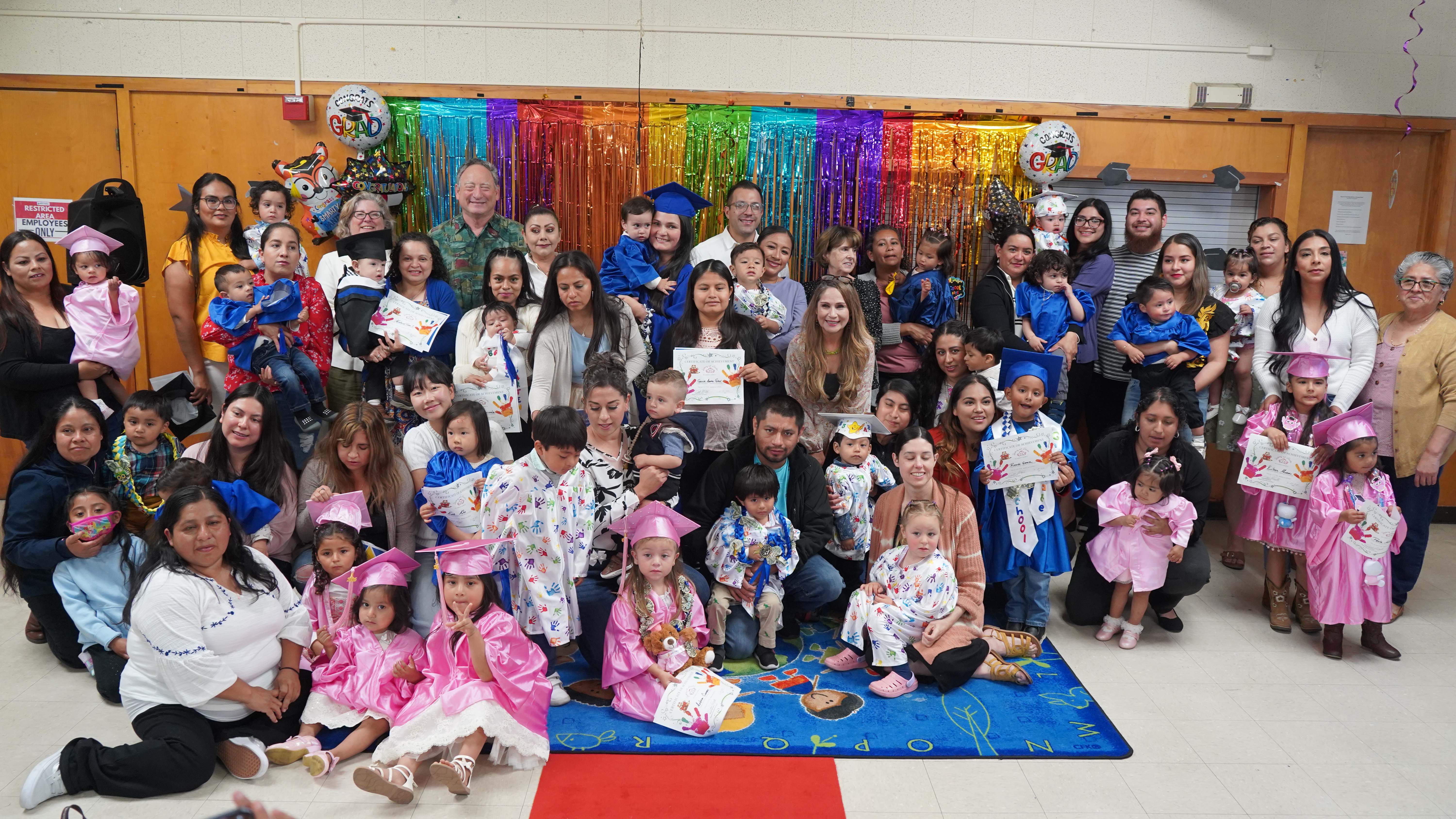
The model has demonstrated a strong impact through positive student feedback, a waiting list for enrollment, and Parent Education enrollment doubling in one year. Participants have also developed a strong sense of community and increased interest in other adult school programs and services
The Unique Features of the Program
The MAS Parent Education model is unique in its braided approach, integrating Parent Education, contextualized ESL, EL Civics, and co-located family support services into one family-centered model. The program strengthens English proficiency, parenting skills, home-school connections, and parents’ ability to navigate education and community systems, while emphasizing play as a foundation for child development.
Designed for parents unable to attend traditional ESL classes due to family obligations, the program embeds practical English instruction and EL Civics into the “Play and Learn” model, creating a layered learning approach that combines parenting education, basic literacy, and real-life skills such as housing and pharmacy navigation. Burlington English extends learning beyond the classroom.
A distinctive feature of the model is its one-stop family support hub, leveraging partners housed on the MAS campus, including the MPUSD Family Resource Center, Women, Infant and Children (WIC) offices, League of United Latin American Citizens (LULAC) monthly meeting space.
1. The Monterey Peninsula Unified School District (MPUSD) Family Resource Center: MPUSD recognizes the importance of the entire family as a foundation for TK-12 student success. By investing in the health of the adults, students have better resources and support to thrive in school. In response to the high rate of McKinney Vento families in MPUSD, the Family Resource Center was established. MPUSD families can receive basic needs (clothing, school supplies and hygiene products) as well as support networking local housing agencies.
2. Women, Infants and Children (WIC): In 2024, MAS Created a partnership with the local WIC services to bring a WIC satellite office onto the MAS campus. Although there were logistical challenges, both entities were committed to creating this partnership with a shared vision to support families with young children.
3. League of United Latin American Citizens (LULAC): With monthly meetings on MAS campus, LULAC has created a space for community members to discuss and give feedback on issues at the local and state level. By opening up this space for LULAC, MAS benefits from the insights of this emerging community group.
Innovative partnerships have led to measurable impact, including a WIC satellite office serving over 900 families with 100 referrals into MAS Parent Education programming, and the bilingual “Let’s Talk Family Summit”, developed with LULAC to strengthen resilience, communication, and family success.
Together, this integrated, replicable model combines education, support services, and partnerships to create a community-centered approach that strengthens families and expands access to adult education.
The Outcome
By leveraging partnerships and creating a safe, family-centered learning environment, MAS Parent Education has demonstrated measurable growth and strong student outcomes through increased enrollment, English skill gains, EL Civics success, and student-driven program expansion.
Key Data Outcomes:
1. Parent Education enrollment grew from 75 families in Spring 2024 to 223 families in 2025-26, with 602 duplicated students participating since launch. Enrollment more than doubled in one year.
2. Participants demonstrated measurable English gains, with 37% CASAS level gains in 2024-25 and 26% gains to date in 2025-26.
3. Students achieved strong EL Civics outcomes, with 93% pass rates in 2024-25 and 95% pass rates in 2025-26 through practical units focused on family life skills. EL Civics units were focused on important family learning: “Pharmacy”, “Nutrition” and “Immigration Rights”.
4. The WIC partnership has served 900+ families, with 100+ referrals into Parent Education since January 2026.
Although the data above shows the positive impact of this program, MAS seeks out the student experience via student surveys and a newly developed MAS Student Advisory Board. Student feedback reflects increased confidence, stronger community connections, and high program demand, including waiting lists and interest in additional services. Feedback has directly informed expansion plans, including additional “Play and Learn” sections, evening parent programming, a father-focused cohort, and basic literacy classes in Spanish and English.
Leveraging existing partnerships with innovative instructional programming, MAS redesigned a traditional adult school into an emerging community-centered hub, integrating Parent Education, ESL, and co-located support services to strengthen families, reduce barriers, and create pathways into continued learning.These partnerships expand access to community services while working within limited adult education funding.
Together, these outcomes demonstrate a scalable model that strengthens families while expanding access to adult education and support services.