
Maximizing Time, Expanding Access: A Flexible, Data-Driven Approach to Adult Education Success
Submitted By: Raul Pedraza Jr.
San Bernardino Community College District Consortium
Website: https://icec.sbcusd.com/programs/academics
Type of Practice: Learner Transition
Program Area(s): ABE / ASE
Region: Inland Empire
Consortia Involved: About Students Regional Consortium, Riverside
The Program of Practice
Adult learners often face barriers that make traditional instructional models difficult to sustain. Many students balance school with work, childcare, transportation challenges, family responsibilities, and other personal circumstances that affect attendance, persistence, and completion. Program data and staff observations showed that fixed schedules, traditional course sequencing, and limited access to instruction were slowing student progress in both GED and high school diploma pathways.
Students also experienced academic overload when managing multiple subjects at once, while high school diploma students did not always have clear pacing expectations for credit completion. In addition, CASAS post-testing was not always viewed by students as meaningful or directly connected to their advancement. As a result, the program identified the need to redesign instructional time, access, course structure, and accountability in a way that better reflected the realities of adult learners while maintaining rigor and improving outcomes.
The Response
In response, Inland Career Education Center developed a flexible, data-driven model focused on maximizing instructional time and expanding access. The program implemented a HyFlex instructional structure that allows students to participate in person or remotely and move between formats as needed. This provides continuity of learning for students whose work schedules, transportation, or family responsibilities may prevent consistent in-person attendance.
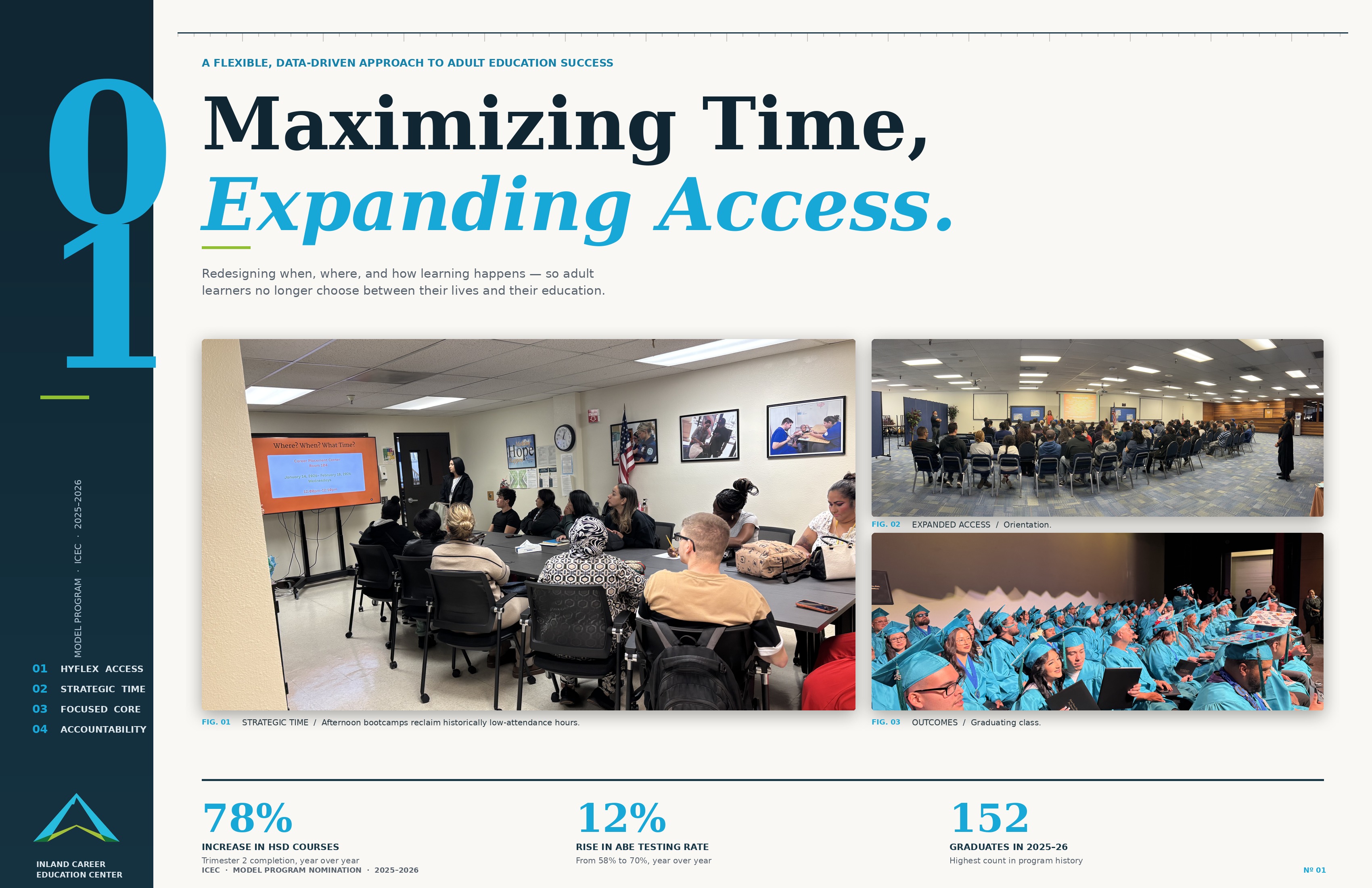
The program also redesigned historically low-attendance time blocks into high-impact afternoon programming, including academic bootcamps, new student orientation, targeted interventions, and skill-building sessions. Instruction was further refined by prioritizing Math and Reading Language Arts during regular instructional time, while Science and Social Studies were offered through accelerated bootcamp cycles. This reduced academic overload and allowed students to build momentum through focused instruction.
For the high school diploma pathway, the program introduced clearer time-bound expectations through a trimester structure. This maintained flexibility while strengthening accountability for credit completion. The ABE and GED course sequence was also redesigned from a two-level structure into a three-level progression model based on CASAS data: Beginning ABE, Intermediate/Advanced ABE, and GED Level. This provided more precise placement, stronger differentiation, and clearer advancement points for students.
The Unique Features of the Program
The unique strength of this program is that it redesigns time, access, instruction, assessment, and accountability as one connected system rather than as separate interventions. The HyFlex model expands access by allowing students to continue learning even when life circumstances prevent them from attending in person. The use of afternoon bootcamps turns previously underutilized time into structured opportunities for acceleration, intervention, and completion.
The program’s subject-specific instructional focus allows teachers to deepen instruction in Math and Reading Language Arts, while short-term Science and Social Studies bootcamps give students an efficient path to complete additional requirements. The trimester model provides diploma students with clear pacing expectations and measurable progress points without removing the flexibility adult learners need.
Another distinguishing feature is the way assessment has been reframed. CASAS testing is no longer viewed only as a compliance requirement. It is connected to student advancement, instructional placement, and access to bootcamp opportunities. This gives students a clear and immediate reason to post-test and helps them see their own growth. Together, these features create a model where flexibility supports rigor, access supports accountability, and time is used intentionally to accelerate student success.
The Outcome
The program has produced measurable improvements in student engagement, assessment participation, credit completion, and overall progress. The ABE testing rate increased from 58 percent the previous year to 70 percent through the end of April, reflecting a 12 percentage point increase. This growth was supported by the intentional connection between CASAS post-testing, level advancement, and access to additional learning opportunities.
High school diploma credit completion also increased significantly. In Trimester 1, completed HSD classes increased from 110 in 2024-2025 to 162 in 2025-2026, a 47 percent increase. In Trimester 2, completed HSD classes increased from 159 to 283, a 78 percent increase. Additional year-to-date data also shows strong progress, with 2025-2026 HSD course completions reaching 334 in Trimester 1, 354 in Trimester 2, and 284 in Trimester 3.
Graduation outcomes also reflect the impact of this redesigned model. As of April 30, year-to-date graduates increased from 78 in 2024-2025 to 104 in 2025-2026. Total graduates also increased from 144 in 2024-2025 to 152 in 2025-2026.
Beyond the numbers, student feedback shows that the model has increased motivation and confidence. Students reported that bootcamps helped them complete requirements and that staff support helped them believe they could finish. These outcomes demonstrate that when adult learners are given flexible access, clear expectations, focused instruction, and meaningful opportunities to accelerate, they are more likely to persist, complete, and move forward toward their educational and career goals.