
Career Pathways for a Changing Community: Corona-Norco Adult School’s IET Transformation
Submitted By: Thoibi Rublaitus
About Students Regional Consortium, Riverside
Website: https://adulted.cnusd.k12.ca.us
Type of Practice: Learner Transition
Program Area(s): ESL / EL Civics / Citizenship, CTE / Workforce Prep / Pre-apprenticeship
Region: Inland Empire
Consortia Involved: About Students Regional Consortium, Riverside
The Program of Practice
The service area of Corona-Norco Adult School is experiencing significant demographic and economic shifts that are reshaping community educational and workforce needs. Rising housing costs in the cities of Corona, Norco, and neighboring communities have increasingly displaced many lower-income families who historically comprised a substantial portion of the Adult Basic Education (ABE) and English as a Second Language (ESL) student population. Simultaneously, continued residential development has attracted a growing number of middle-income families, working professionals, and senior citizens relocating from higher-cost regions such as Los Angeles and Orange Counties.
As a result of these demographic transitions, traditional enrollment patterns in foundational adult education programs, particularly ESL and ABE, have declined. At the same time, labor market demand—especially in healthcare and allied health occupations—has intensified, creating an urgent need for workforce-responsive education and training pathways.
Compounding this shift, the profile of English language learners in the region has evolved. Increasingly, ESL students are highly educated immigrants and internationally trained professionals who bring prior academic credentials, professional expertise, and workforce experience from their countries of origin. However, many face barriers related to English language acquisition, credential recognition, digital literacy, and navigation of the U.S. workforce system, preventing them from fully participating in occupations aligned to their skills and experience.
This changing demographic and workforce landscape created a critical challenge for Corona-Norco Adult School: how to reimagine traditional adult education programming to meet the evolving needs of a more educated multilingual learner population while simultaneously addressing regional workforce shortages in high-demand sectors such as healthcare. The need called for an innovative, integrated approach that could accelerate language acquisition, workforce readiness, and occupational credential attainment in a manner that was both equitable and responsive to local economic demand.
The Response
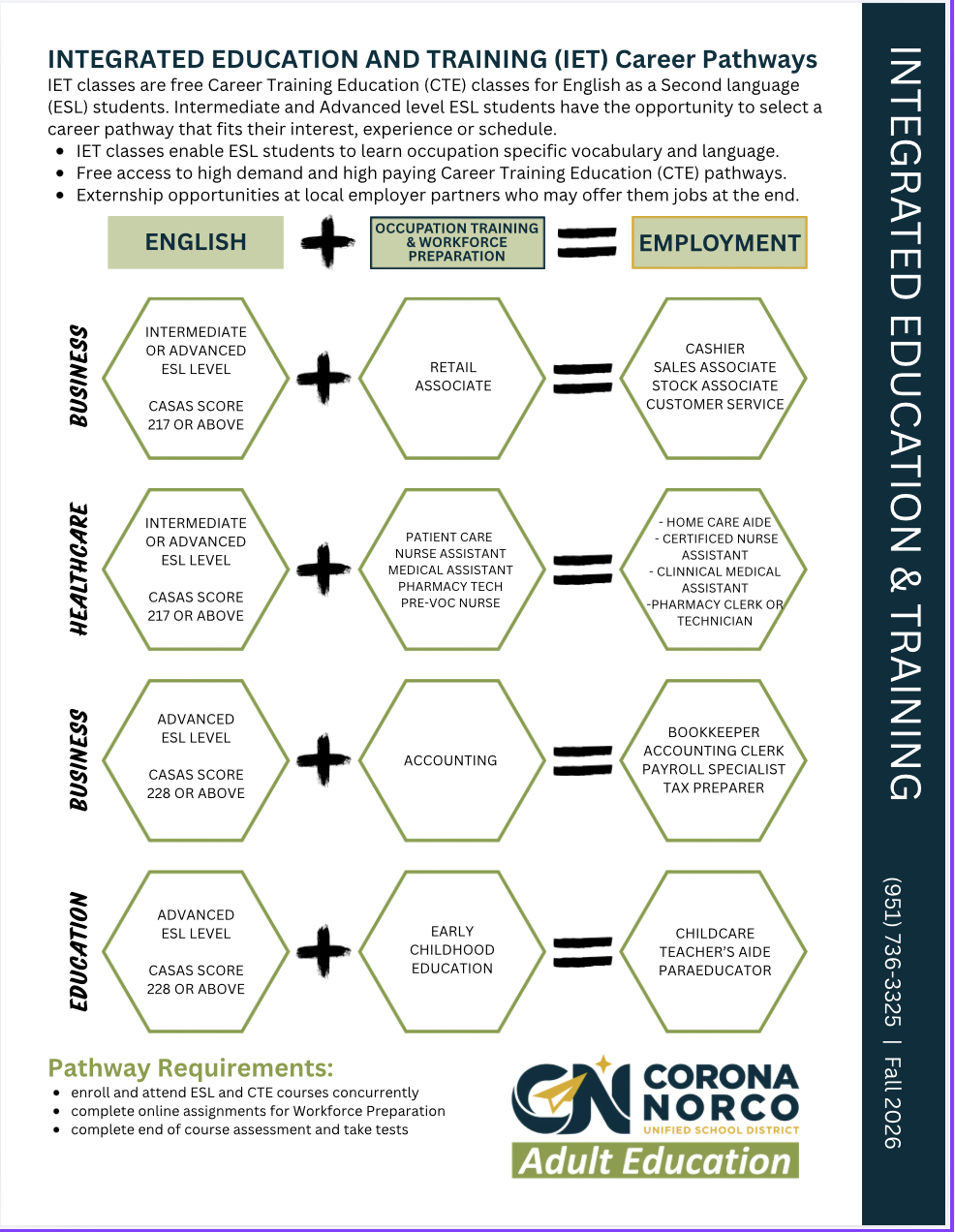
In response to changing demographics, evolving student needs, and increasing regional workforce demands, Corona-Norco Adult School fundamentally reimagined its adult education delivery model by expanding career-connected, workforce-responsive programming through Integrated Education and Training (IET).
Over the past three years, the school strategically expanded from three to eight IET pathways, intentionally aligning programming to local labor market demand and the emerging profile of multilingual adult learners—many of whom are highly educated immigrants with prior professional experience from other countries. Rather than viewing declining traditional ESL and ABE enrollment as a challenge alone, the school leveraged this shift as an opportunity to redesign educational access and accelerate workforce entry for adult learners.
Corona-Norco Adult School now offers IET pathways leading to Industry-Recognized Training Certificates (IRTCs) in high-demand fields including Customer Service, Early Childhood Education, Accounting, Home Health Aide, Certified Nursing Assistant (CNA), Medical Assistant, Pharmacy Technician, and Pre-Vocational Nursing. Each pathway integrates English language acquisition, workforce preparation, and occupational skills training through a single set of learning objectives, enabling students to simultaneously build English proficiency, workforce competencies, and career credentials.
This restructuring created an accelerated, career-focused model that better serves multilingual adult learners while directly responding to regional workforce shortages, particularly in healthcare. By integrating language learning with occupational training, students are able to transition more efficiently into employment, career advancement, and postsecondary opportunities while contributing to the economic vitality of the region.
The Unique Features of the Program
A defining feature of Corona-Norco Adult School’s model is its rapid transformation from an adult school with no Career Technical Education (CTE) offerings to a robust, career-connected system of Integrated Education and Training (IET). Recognizing that strong IET requires strong occupational training, school leadership strategically pursued competitive grants, leveraged district high school CTE instructors, collaborated with community members such as United Way 211, and intentionally built workforce-responsive career pathways.
Using a continuous improvement approach, CNAS implemented multiple IET delivery models—including I-BEST co-teaching, alternating, and cluster models—learning from each pilot and expanding pathways over time. In just three years, the school grew from three to eight IET pathways, offering Industry-Recognized Training Certificates (IRTCs) aligned to regional workforce demand, particularly in healthcare, a year before the ELL IET Round 1 funding was released.
A key strength of the program is its sustainability model. CNAS strategically braids and blends funding sources—including CAEP, WIOA Title II, EDD ELL IET, CalWORKs, and SNAP Employment & Training—to sustain and expand programming. This approach positioned the school for inclusion on the Eligible Training Provider List (ETPL) and ongoing Council on Occupational Education (COE) accreditation efforts, preparing for future Workforce Pell opportunities.
The program’s innovation and impact have attracted substantial state investment and partnerships. CNAS received a $2.3 million EDD ELL IET Pathways grant and was selected as one of only eight grantees statewide to participate in a technical assistance Community of Practice led by the International Rescue Committee (IRC). Today, the school sustains 32 MOUs with local employers and community partners to support training, clinical experiences, and employment pathways. CNAS also received one of California’s largest WIOA Section 243 IELCE awards, second only to Los Angeles Unified School District in 2023-24.
The Outcome
Corona-Norco Adult School’s intentional expansion of Integrated Education and Training (IET) pathways has resulted in substantial growth in student attainment of Industry-Recognized Training Certificates (IRTCs). As pathways expanded and instructional models matured, student certification outcomes increased significantly—from 69 certifications in SY 2023–24 to 241 certifications in SY 2024–25, representing a 249% increase in one year. Through the third quarter of SY 2025–26 alone, students had already earned 156 industry certifications, placing the school on pace to sustain strong outcomes.
Growth has been particularly strong in high-demand workforce sectors. Healthcare pathways produced strong outcomes, including 44 Nurse Assistant certifications in SY 2024–25, alongside growing completion numbers in Medical Assistant (35) and Pharmacy Technician (31) programs. Workforce and business pathways also expanded significantly, with notable gains in Accounting (8 to 34), QuickBooks (13 to 25), Bookkeeping (15 in its inaugural year), and Customer Service (9 to 30) certifications. Early Childhood Education remained a consistent pathway, producing 26, 23, and 13 certifications across the three school years.
Further demonstrating program quality and workforce alignment, Corona-Norco Adult School successfully placed four workforce training programs on the Eligible Training Provider List (ETPL) in SY 2025–26, increasing access for students to Workforce Innovation and Opportunity Act (WIOA) Individual Training Accounts (ITAs) and strengthening pathways to employment in high-demand occupations.
These outcomes demonstrate not only the rapid scaling of Corona-Norco Adult School’s IET model, but also the school’s ability to align workforce training with regional labor market demand while accelerating multilingual adult learners’ access to employment and career advancement.