
NOCE Holistic Student Services
Submitted By: Deb Perkins
North Orange County Regional Consortium for Adult Education (NOCRC)
Website: https://noce.edu/student-services/
Type of Practice: Learner Transition
Program Area(s): ABE / ASE, ESL / EL Civics / Citizenship, CTE / Workforce Prep / Pre-apprenticeship
Region: Orange County
Consortia Involved: North Orange County Regional Consortium for Adult Education (NOCRC)
The Program of Practice
Noncredit students often face very high levels of need that directly impact their ability to succeed. According to a recent #RealCollege California survey, these students experience widespread food insecurity, with 22% relying entirely on college food support to meet basic nutritional needs and 93% reporting receiving some form of food assistance from their institution. Many identify meal skipping, hunger, and lack of balanced meals as key barriers to academic success. In addition, students face severe financial instability: 39% report borrowing money in the past year just to survive and pay bills, 25% earn less than $16.50 per hour, and 41% are actively seeking employment, reflecting ongoing economic insecurity. Housing challenges are also significant, as 29% struggle to pay rent, 15% rely on temporary housing such as couch surfing, and 6% experience homelessness, alongside issues like frequent moves, unsafe living conditions, and utility non-payment. Mental health and overall wellness concerns further compound these challenges, with 22% of students reporting psychological disabilities and many coping with chronic illness, disability, or other health-related barriers that affect persistence. At the same time, students must balance additional responsibilities such as work schedules, childcare, transportation barriers, and immigration-related stress. As a result, many students “stop out” due to life circumstances rather than a lack of motivation. Furthermore, engagement can be a challenge; like all students, noncredit learners need to feel included, represented, and that their voices are heard and valued in the learning environment.
The Response
To address this, NOCE provides comprehensive student services including basic needs support, affinity group programming, and a peer-based case management program.
The NOCE Basic Needs program is designed to reduce barriers to student success by addressing essential, non-academic needs that directly impact persistence and engagement. The program provides a comprehensive range of supports, including food access through an on-campus pantry, housing navigation for students experiencing or at risk of homelessness, technology support such as laptops and hotspots, transportation assistance through a pilot bus pass program, clothing resources, scholarships and book awards, and access to mental health and counseling supports. Through coordinated referrals and partnerships (e.g., CARE Team, Pathways of Hope, and community agencies), services are targeted toward students with the greatest need while remaining broadly accessible to enrolled students. Collectively, these efforts aim to stabilize students’ basic living conditions, remove financial and logistical obstacles, and create equitable access to education so students can focus on their academic and career goals.
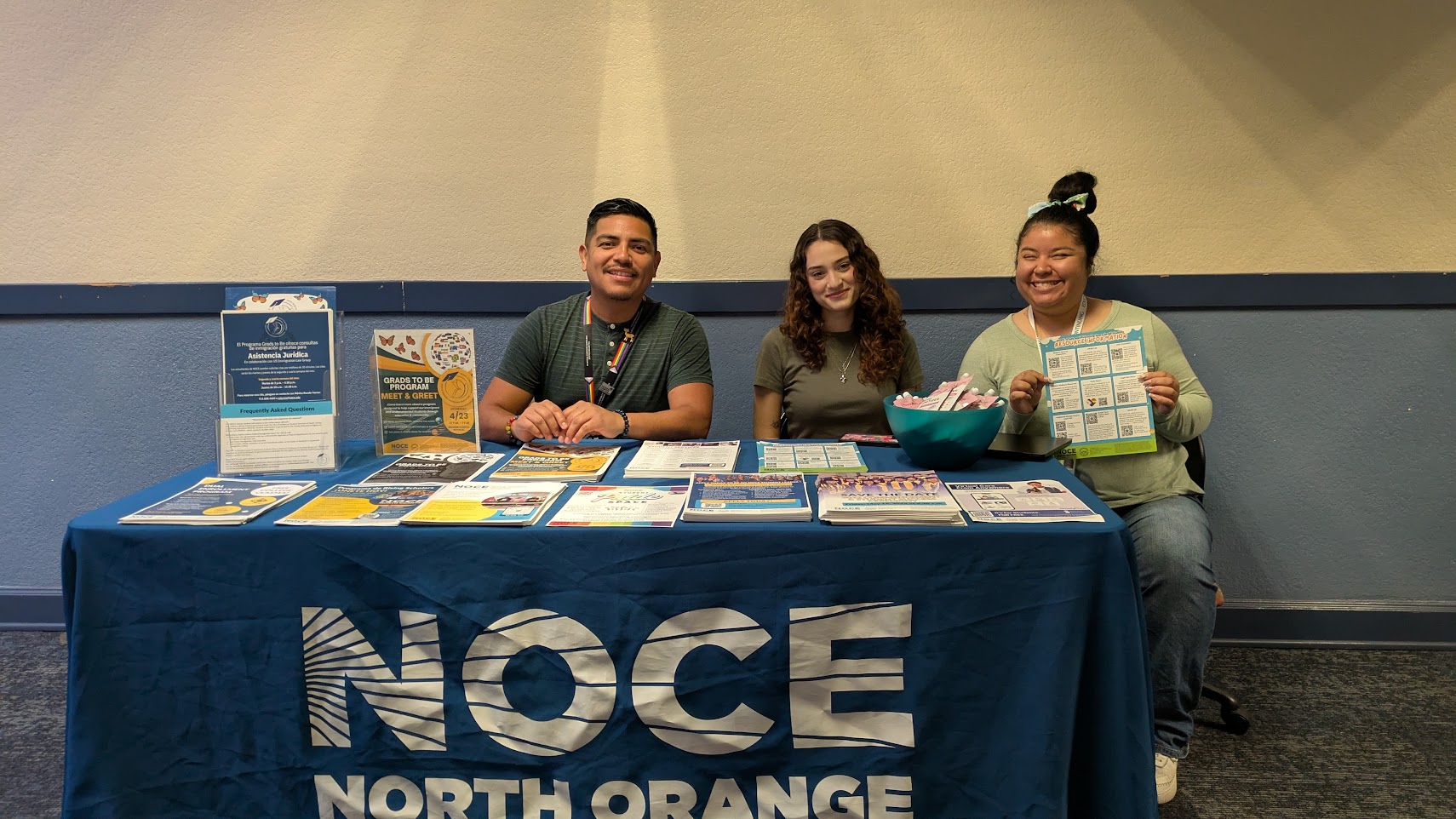
NOCE’s affinity group programming include the Rising Scholars and RISE Youth Program, which support formerly incarcerated adults and those impacted by the juvenile justice system respectively; the Grads to Be program, which supports students who are undocumented, from mixed status families, and allies; and the Pride Space. Programming within these programs includes specialized academic counseling, workshops, referrals to resources including legal aid, and community building events. The programs also coordinate and lead professional development training to ensure all campus employees are supportive and understanding of the needs of students in these programs. The Counseling and Student Services department also oversees the Student Leadership Program. This program is focused on helping current students grow as leaders, develop communication skills, serve the community through active student participation and representation, and prepare for candidacy for the NOCE Student Trustee position. It provides a voice for students in shared governance committees within NOCE and the district and Student Leaders serve as representatives of NOCE at local and state events, such as the annual Noncredit Summit.
The Student Success Navigator program complements these supports by providing proactive, high-touch outreach and case management focused on improving student persistence, retention, and completion across key populations, including ESL, CTE, high school diploma, and special populations. Navigators identify and engage students who are at risk—such as no-shows, stop-outs, and those with low attendance—conducting targeted outreach, connecting them to resources, and guiding them through enrollment, planning, and support services. The program emphasizes re-engagement, consistent communication, and coordinated referrals, resulting in thousands of student interactions and measurable improvements in retention in programs such as CTE and basic skills. By combining data-informed outreach with personalized support, the Navigator model strengthens student connection to the institution and plays a critical role in improving overall student success outcomes.
Academic counselor play a critical role in helping students achieve their educational and career goals by serving as both a guide and a support system throughout their journey. Counselors build meaningful relationships with students, understand the complex challenges they face—such as work, family responsibilities, and financial barriers—and take intentional action to address those needs. Through proactive and intrusive interventions, counseling helps remove barriers, connect students to essential resources, and ensure they receive the information and support necessary to persist. In addition to individual counseling appointments, counselors proactively connect to students through classroom presentations and drop-in hours in NOCE academic labs to provide information about counseling and student services, complete group student education plans, and graduation applications.
The Unique Features of the Program
NOCE uses a guided pathways framework when developing programs and services. The Counseling and Student Services department continues to grow and adapt to serve students from before they enroll through their entire journey at NOCE and beyond. We use intrusive interventions to demonstrate to students that we care, reduce barriers to accessing support services, and we have streamlined and structured processes to show that we value students’ time and ensure students get the necessary information and support to meet their goals. We build on community partnerships to raise awareness about NOCE programs and services, as well as to refer our students to resources they need to be successful.
The Outcome
For our Basic Needs programs, we have seen a huge increase in the number of students accessing services. During this fiscal year, the Food Pantry recorded 8,637 total visits which supported 32,897 students and their family/household members, reflecting continued need for these essential services. In addition to its regular hours on Tuesdays and Wednesdays, the pantry expanded access by introducing Thursday distributions, allowing students with an additional opportunity to be nourished. Student Technology Support Services (STSS) distributed 434 laptop loans and 106 hotspot loans, in addition to assisting hundreds of students with essential technology needs to support their academic success. The Book Award program has grown from 129 awardees in 2021-2022 to 1,093 awardees in 2025-2026. This year, the Basic Needs Program expanded to offer diaper services, a pilot bus pass program, CalFresh application support, and clothing vouchers and beginning in 2026-2027, will launch the Fresh Success program.
During 2025–2026, Rising Scholars, Grads to Be, and Pride Space hosted a comprehensive series of workshops, wellness events, legal resource sessions, and community celebrations. These included trauma-informed seminars, Know Your Rights trainings, identity and belonging workshops, emotional wellness programming, and culturally affirming events such as Tamales & Cheer. Promotional outreach through flyers and email campaigns supported strong participation and awareness, reinforcing each program’s role in fostering connection, advocacy, and student success.
A team of ten Student Success Navigators support students across ESL, CTE, High School Diploma, and as part of our United Domestic Workers (UDW) partnership, with support from our Counseling and Student Services Coordinator and Specialist. In spring 2026, 4,230 students were supported by the Student Success Navigator program. There have been over 10,000 student interactions since the launch of the program in fall 2024 and in fall 2025, we saw at 16% re-engagement rate for ESL students who had been contacted based on attendance. We are also seeing positive trends in course retention and term to term retention outcomes since the start of the Student Success Navigator program. In instructional programs that had Student Success Navigators, we saw course retention (students were retained until the end of the course) increase from 71% to 80% in the high school diploma program from 2023-2024 (prior to the Navigator program) to 2024-2025 (pilot year of the Navigator program). We saw a similar increase for ESL with course retention going from 57% in 2023-2024 to 64% in 2024-2025. We also saw an increase in term to term retention with the high school diploma program increasing from 35% in 2023-2024 to 44% in 2024-2025 and ESL remaining steady at 56%. We know there are a lot of external factors that impact students’ enrollment, so we see steady enrollment in ESL as a success. During the summer of 2026, we will be working with our Office of Institutional Research and Planning on a comprehensive evaluation report.
Data from recent years demonstrates notable progress in student engagement with key counseling services, particularly in the completion of orientations and student educational plans (SEPs). Among NOCE CDCP students receiving services, orientation completion increased from 56% in 2023–2024 to 63% in 2024–2025, while SEP completion rose significantly from 37% to 47% during the same period. These upward trends reflect strengthened counseling practices and more effective integration of support services into the student experience, contributing to greater engagement and improved student outcomes.